

The number of public electric vehicle charging ports in Washington state has more than doubled in the last four years. There are now more than 2,600 EV charging stations open to the public, offering about 7,000 charging ports, up from roughly 3,500 ports in 2021. But this rapid expansion is only the beginning of the Washington State Department of Transportation’s efforts to support and promote a switchover to EVs.
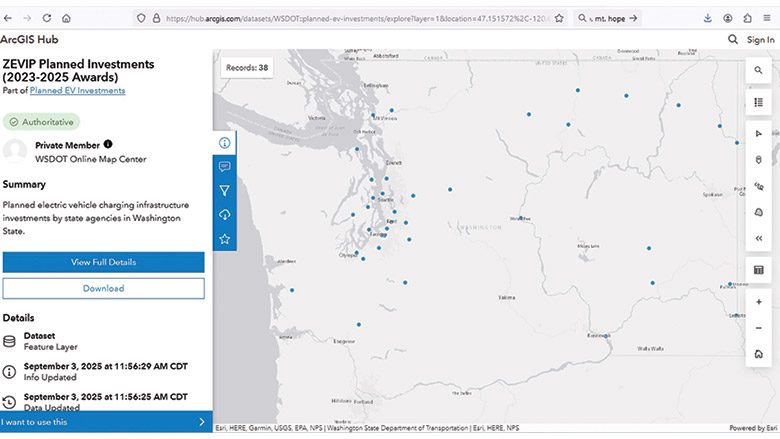
There were more than 200,000 registered EVs in the Evergreen State in 2024, making up more than 20% of new car sales. To meet both current and future demands for EV charging infrastructure, WSDOT partnered with the Washington State Department of Commerce to create the EV Mapping and Planning Tool (EV-MAP), an interactive map built on Esri GIS technology that brings together 100 public datasets related to EV infrastructure and demand. Among the layers in the map are existing charging stations, planned EV installations (grant-awarded projects not yet built), traffic counts and pre-modeled travel routes, as well as EV registrations and forecasted needs broken out by county and block group. The pre-modeled trips and traffic counts can help motorists plan travel.
The tool is designed for local governments, utilities, and businesses to assess and plan their future EV investments. State agencies can access and share data related to EVs among themselves by adding their data to the layers of the map. “This is meant for planners and for communities that are considering investing in EV charging, to know where the best places would be for charging infrastructure, to plan ahead to see how many electric vehicles are likely to be registered in their communities, so they know how many chargers they may need in the future,” says Tonia Buell, alternative fuels program manager at WSDOT.
She notes the mapping tool also offers a way to coordinate among all the state agencies that are involved EV space that have grant programs and can help communities or private developers looking to invest in charging infrastructure. Parts of neighboring states and Canada are included in the datasets behind EV-MAP.
Clicking on any existing charging site gives the user information such as what kind of charger it is and what plug it has (such as Tesla Supercharger, Combined Charging System or J1772) and how quickly they are able to charge. Other information available includes what type of energy source powers the charger, such as renewable hydropower. EV registration data can be viewed through the maps layers. Planners can look at data such as overburdened communities, a dataset that merges several data sources to identify census tracts where vulnerable populations face environmental and health impacts and whether they’re underserved. These include communities defined as disadvantaged by the federal Climate and Economic Justice Screening Tool.
“This has been one of the top markets from the beginning,” says Buell, who co-created the West Coast Electric Highway network—which opened in 2012 along Interstate 5, Highway 99 and other major roadways in British Columbia, Washington, Oregon and California. Buell says, “It’s growing. EVs are here to stay in Washington state, and we want to make sure that people can find places to charge. It’s really important just for range anxiety.”
Buell says WSDOT wants people on the fence about buying an EV to know that EV-MAP can provide information about their daily and long-distance trips.
Much of the EV infrastructure development planned in Washington is funded by grants approved by the state legislature. Buell says vehicle-infrastructure partnerships, a public private partnership grant program for charging infrastructure through WSDOT and private developers, have helped build out hundreds of charging locations along roadways that wouldn’t otherwise have charging available because they might not be profitable enough to drive private investment.
Buell adds that the next challenge is transitioning class 2B to class 8 gas trucks to electric or hydrogen power.