Skip to content
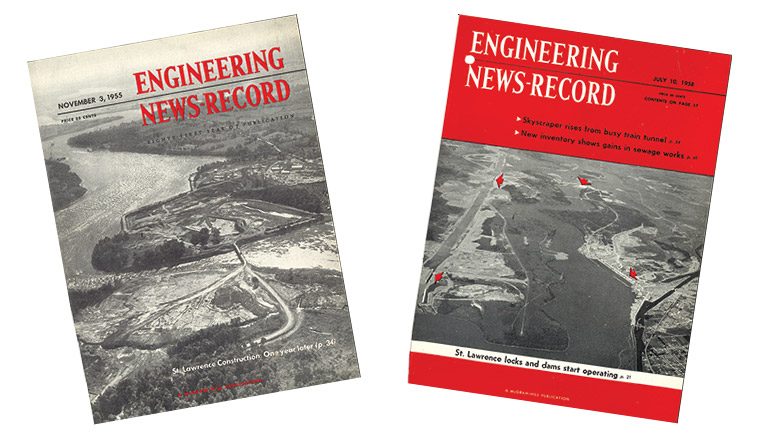


By the 1930s, the century-old system of Great Lakes shipping channels no longer met Canada’s economic needs, and the country was eager to expand. Shipping was hampered by 21-ft-deep channels that resulted in cargo being offloaded to oceangoing ships at ports like Montreal. But any solution had to be mutually acceptable to the U.S., which shared jurisdiction of the lakes and their outlet to the Atlantic, the St. Lawrence River.
A binational treaty for combined navigational improvements and hydropower buildout failed to garner enough votes in the U.S. Senate in 1934. At the treaty signing preceding the failed vote, President Herbert Hoover, a former mining engineer, predicted it would be “the greatest internal improvement yet undertaken on the North American Continent.” Another push in 1941, backed by President Franklin Roosevelt and Prime Minister Mackenzie King, also failed in the Senate, halted by opposition from Atlantic and Gulf Coast ports, railroads and the oil and coal industries. Ports and railroads were worried they’d lose business, while fossil fuel interests feared being undercut by cheaper hydropower.
Eventually Canada threatened to proceed unilaterally. That spurred President Dwight Eisenhower to press Congress to support a new plan, a year-long slog that finally succeeded in 1954. By that time design work had long since been done. The plan called for deepening shipping channels linking the four westernmost Great Lakes and a complex re-plumbing of a 35-mile-long, rapid-filled stretch of the St. Lawrence River on the New York-Canada border just upriver from Montreal.
The program began with construction of two cofferdams to enclose the site for the Barnhart Island power plant. The job drew intense interest, with 40 firms bidding and Montreal-based Mannix-Raymond Ltd. winning out. One plug was a 500-ft-long rock-and-earthfill dam across the north channel of the St. Lawrence, from Sheek Island on the Canadian side to Barnhart Island on the U.S. side. Two miles down river, after the removal of dense, boulder-strewn glacial till, a far larger structure took shape: a 4,500-ft-long cofferdam consisting of 60 circular sheetpile cells, stretching from the Ontario mainland to Barnhart Island.
Image from ENR Archives
Immediately after the cofferdams were completed and the riverbed dewatered, two contractors began excavation work for the powerhouse. Work was split evenly, with a joint venture called Iroquois Constructors on the Canadian half, while a joint venture of U.S. heavyweight firms: Walsh, Perini, Morrison-Knudsen, Peter Kiewit and Utah built the American half, under the direction of the New York State Power Authority, led by Robert Moses.
Straddling the river, the powerhouse is 195 ft tall, 3,216 ft long, and features 32 turbines, with a generating capacity of 1,957 MW. The Canadian and American teams had contrasting approaches to the concrete work. The Canadians, given their familiarity with frigid conditions, placed concrete continuously, relying on the insulating value of wood forms and higher lifts that provided more internal heat. The Americans confined their placement to an eight-month season, using steel forms that saved time and labor, and shorter lifts.
The second-largest structure, the Long Sault Dam, a 2,960-ft-long, 114-ft-high concrete control structure with 30 spillway sections, straddles the river’s south channel at the western end of Barnhart Island. It was also built by the joint venture of major U.S. companies.
Image from ENR Archives
The Badgett Mine Stripping Corp. of Kentucky was the winning bidder for the Long Sault Canal, the longest navigation channel of the project. It employed “the Gentleman,” a 650-ton dragline from the Kentucky coal fields with an 85-ft-long boom, to remove 3.9 million cu yd of hard glacial rock and marine clay to form the 10-mile-long channel and also build a 300,000-cu-yd embankment. The 27-ft-deep, 442-ft-wide canal bypasses the Long Sault rapids and carries St. Lawrence Seaway traffic south of the river channel. Badgett’s work was overseen by the U.S. Army Corps of Engineers, construction agent for the U.S.-side owner, the St. Lawrence Seaway Development Corp. (SLSDC).
The worst trouble spots were the two locks on the Long Sault Canal. A 1955 ENR article stated, “Shifted 498 ft in planning, to avoid a dangerous fault line, this lock [Grass River Lock] has been moved into a spot underlain with the troublesome marine clay. The only good description of this clay is that it looks and digs like blue cream cheese … [the contractor’s] rear-dump trucks slip and sink in this miserable material.” Dutcher Construction Corp., the contractor tasked with removing 3 million tons of the clay, was plagued by rubbery haul roads and a sticky disposal area and went bankrupt.
For the Robinson Bay Lock, excavation had to go 120 ft down through boulder-strewn glacial till. The contractor, Jack & Jim Master Inc., chose to use scrapers instead of power shovels, and ended up defaulting, replaced by the Tecon Corp.
Flooding caused by the powerhouse’s construction inundated 16.5 sq miles of farmland and eight villages, requiring relocation of 6,500 people and the shifting of 34 miles of roadways and 40 miles of railways, mostly on the Canadian side.
Iroquois Dam, 25 miles upstream from Long Sault, is for control at the head of the power pool. It is a 1,910-ft sluiceway structure which joins the wall of a navigation lock at its Canadian end. Massena Intake, the fourth and last major river control structure of the project, is a 692-ft gravity concrete dam. It incorporates four gated openings and a large pump station, and serves as a potable water intake for the town of Massena, N.Y.
Forty miles downstream from Long Sault, the Beauharnois Canal was taking shape. A team of dredges had been digging this 15.5-mile bypass of the Soulanges Rapids, operating eight months per year since 1930. The centerpiece of the operation was the world’s most powerful dredge, a cutterhead suction dredge with a 42-in. head and a 17-ft-dia pump, capable of passing boulders up to 38 in. across and weighing 1,500 lb. It was accompanied by two other dredges, 9,000 ft of floating pipe, 43 other pieces of floating equipment like scows, and a workforce of 600. By completion in the mid-1960s, 220 million cu yd of material had been excavated.
The Beauharnois power station, completed in 1961, is 3,050 ft long and 80 ft tall, with a generating capacity of 1,903 MW.
A money-saving materials handling technique employed was the pneumatic transport of cement. Bulk cement was fed into a pipe using a motor-driven screw, and pressurized air was injected. A crew could empty a 2,700-ton shipload of cement in 24 hours. The pumps conveyed the cement 4,200 ft to the batch plants via a 10-in.-dia pipe. The dock-to-dam pneumatic system was designed by Fuller Co., which had originally developed it as a way to move pulverized coal.
To allow oceangoing ships to access the newly-deepened Seaway canal, the Jacques Cartier Bridge had to be raised 80 ft on the Montreal side. This complex operation involved jacking up 14 of the 16 spans at the south end. The bridge was so vital it had to remain in service, so traffic was diverted onto two lanes of Bailey bridging and temporary access roads. The spans were raised 6 in. at a time, and at intervals of 2 ft, concrete courses were poured on the piers.
On July 1, 1958, Dominion Day in Canada, the last cofferdam was blasted apart, enabling the river’s full 240,000 cu ft per second flow to form 25-mile-long Lake St. Lawrence over the next three days, as well as fill the Seaway canal and the locks on the New York side. The power plant’s turbines were installed and operational by 1959, along with the four downstream locks. The workforce totaled 22,000 and the entire project cost $1 billion.
As the project was nearing completion, a power struggle erupted over operations. The SLSDC, commissioned by Congress to build and operate the toll facility, expected to staff the U.S. components of the waterway. But the Corps believed it should handle operations, given its experience with many other locks and dams on the Mississippi River, as well as the Panama Canal. Shipping companies looking for low tolls backed the Corps, since all the Corps-operated waterways operated toll-free. East Coast ports, fearing the competition of a low-toll Seaway, favored the SLSDC, which won out in the end as operator. Today, the Corps is tasked with maintaining and improving the Seaway.
The effort to deepen the various connecting channels of the four western Great Lakes kicked off in 1957 and lasted five years. It entailed deepening the Detroit River in Lake St. Clair, the St. Clair River between Lake Erie and Lake Huron, and St. Mary’s River and the Straits of Mackinac between Lake Huron and Lake Superior. It involved a workforce of almost 1,000 and the mobilization of a vast fleet to dredge 44 million cu yd of material: eight large hopper dredges; two large hydraulic dredges; and one seagoing hopper dredge, with each dipper dredge attended by two tugs, a derrick boat, one or two launches and two to four dump scows. In channels with rock bottoms, drilling and blasting was done with the use of specialized drill boats.
Oceangoing vessels gaining access to the Great Lakes significantly increased shipping volume. As a result, the Calumet-Sag channel serving the vast industrial area in South Chicago was expanded, so that commerce between Great Lake ports and the Mississippi-Ohio-Missouri river system could grow further.