

An important lawsuit involving general contractor Spawglass, a subcontractor and a fatal 2019 Texas traffic accident was debated before an appeals panel of Texas Supreme Court judges today in Austin. At stake is the immunity from lawsuits granted by state law to contractors who work on Texas Dept. of Transportation projects and whether the law gives immunity to all contractors working on its highways or only those directly contracted with TxDOT.
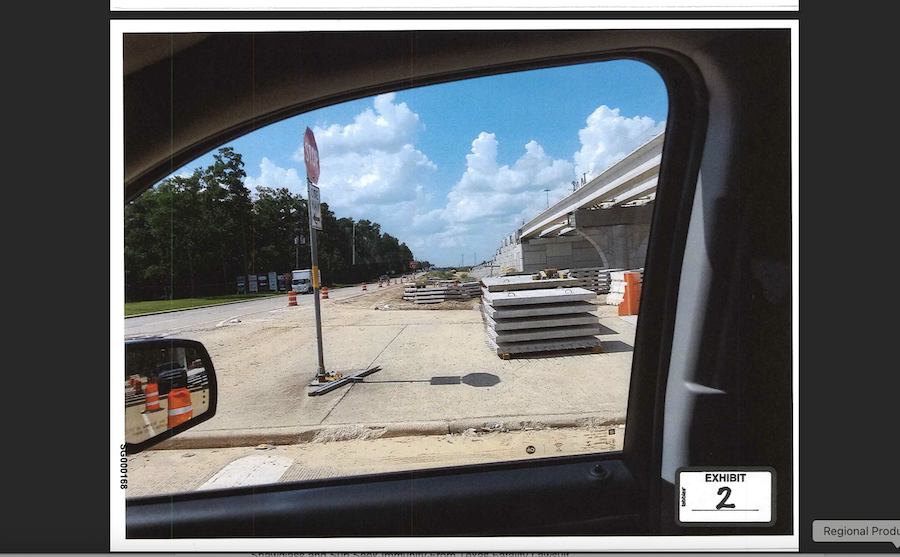
It all started in August 2019, when Pedro Castaneda, 53, apparently stopped at a stop sign before turning onto a frontage road on Texas State Highway 249 in Magnolia in Montgomery County, north of Houston. But after stopping he then seemingly failed to yield to oncoming traffic.
Two vehicles hit Castaneda’s SUV before it struck a power power pole, causing the line to fall and his car to catch fire.
A local contractor, Magnolia-based Third Coast Services LLC, had been tasked with installing the new traffic signals by the project’s general contractor, Houston-based SpawGlass Civil Construction Inc. SpawGlass had been hired by Montgomery Count to build an overpass for SH 249 above a road leading to the intersection as part of a TxDOT-Montgomery County project. The contractors had installed and covered the new traffic signals until activation by the electric utility, leaving a stop-sign as the main traffic signage at the critical road juncture where Castaneda made his turn.
In Nov. 2019 Castaneda’s family sued in state court in Harris County a number of companies connected to the overpass project. The family later added Third Coast and SpawGlass as defendants, alleging Third Coast’s actions and omissions directly contributed to the dangerous condition of the intersection.
Specifically, the family alleged that Third Coast improperly covered the traffic signal heads, violating TxDOT standards and causing Castaneda’s confusion. They also charged that both companies ignored what they claim were at least 10 prior accidents at the intersection and failed to modify traffic controls or reinspect the signals promptly after an initial failed inspection eight months earlier.
These lapses, the family argued, contributed to Castaneda’s fatal decision to enter the intersection at the time.
Third Coast and SpawGlass denied any wrongdoing.
The two companies also sought to have the lawsuit dismissed by invoking Texas Civil Practice and Remedies Code § 97.002, which protects contractors working on TxDOT highway projects if they comply with contract documents. Third Coast argued that it fully complied with its subcontract to install and cover the traffic signals, as verified by Montgomery County and SpawGlass, and that Castaneda’s failure to yield to vehicles with the right-of-way was the primary cause of his accident.
The defendants also argued that their work on the SH 249 Project, designed and approved by TxDOT, and with the electrical permit in TxDOT’s name, qualified as working for TxDOT.
The contractors cited a prior case which held that direct contract (privity) with TxDOT is not required to receive immunity.
The trial court denied the contractors’ summary judgment motions—seeking a decision by a judge before a full trial— filed in Nov., 2022. The contractors appealed that decision and lost again, when the Texas Court of Appeals ruled that direct contracts with TxDOT was required for immunity.
The contractors then contested that loss in another appeal, this time to the Supreme Court of Texas, which heard oral arguments today.
Industry associations, including the American Subcontractors Association and a coalition including the Texas Building Branch of the Associated General Contractors, saw the matter as critical and jumped in with friend-of-the-court briefs. They argued for a broad interpretation of § 97.002.
Threat to Livelihoods Feared
ASA’s brief grappled with the risk that it claimed subcontractors will shoulder if privity is required for immunity on highway jobs.
“Subcontractors commonly perform approximately 80-90% of the work on commercial and public construction projects and thus are an integral backbone to the economy…ASA’s primary focus is the equitable treatment of subcontractors in the construction industry, [and] the Court of Appeals’ decision in this case [requiring privity] threatens the livelihoods of subcontractors who rely on statutory immunity under Section 97.002.”
The upcoming Supreme Court ruling will address three key issues: whether § 97.002 requires privity, whether traffic signal installation constitutes highway construction, and whether the defendants complied with contract documents.
If the Texas Supreme Court limits immunity to contractors with direct TxDOT contracts, subcontractors may need or reevaluate their risk management approach because they would be exposed to increased liability. On the other hand, the court could reverse the previous rulings and affirm the broader interpretation, extending immunity to contractors and subcontractors working for TxDOT projects.
Either way, the risk landscape in Texas will be defined by what at first seemed like an ordinary overpass project and a terrible tragedy that took a man’s life.