

Tim McCoy
Director of Strategy
Tarlton Corp.
Whether it’s an airport renovation, water treatment facility replacement or ground-up hospital construction, large-scale projects are shaping the construction industry in the St. Louis area, and business is thriving, McCoy says.
“As a metro region, our strength lies in our diversification, [including] expanding transportation and logistics infrastructure—[such as] airports, highways and distribution facilities—[as well as] health care and life sciences investments and accelerating development in data centers and mission-critical facilities,” McCoy says.
He cites numerous large projects, such as the $3-billion expansion of St. Louis Lambert International Airport, which includes consolidating Terminal 1 and Terminal 2 into a single terminal with up to 62 gates, construction of an onsite garage and roadway improvements.
Not far from the airport, Boeing is engaged in a $1.8-billion expansion of its advanced fighter jet manufacturing facility. The 1.1-million-sq-ft project at the Boeing Defense, Space and Security campus will support advanced assembly facilities and the associated post-assembly operations center for future generations of advanced aircraft, Boeing says.
In the broader region, Missouri American Water is investing more than $500 million in its water and wastewater systems statewide. The investments are focused on improving system reliability and resiliency by replacing aging infrastructure like pipes, pumps and storage tanks and upgrading treatment plants.
Tarlton, in a joint venture with Goodwin Bros., is delivering a design-build replacement of St. Louis County’s largest water treatment facility.
On the health care front, SSM Health is building a 14-story, 200-bed pediatric hospital in St. Louis. Slated for completion in 2027, it will feature expanded neonatal and pediatric intensive care units as well as specialized areas for cancer and cardiology care.
In addition to the aviation, manufacturing and health care sectors, “we’re also seeing continued momentum in advanced manufacturing, higher education, energy and power, commercial and institutional sectors and multifamily housing,” McCoy adds.
“I predict the ACE community in St. Louis will have plenty to deliver in 2026 and beyond.”
—Tim McCoy, Director of Strategy, Tarlton Corp.
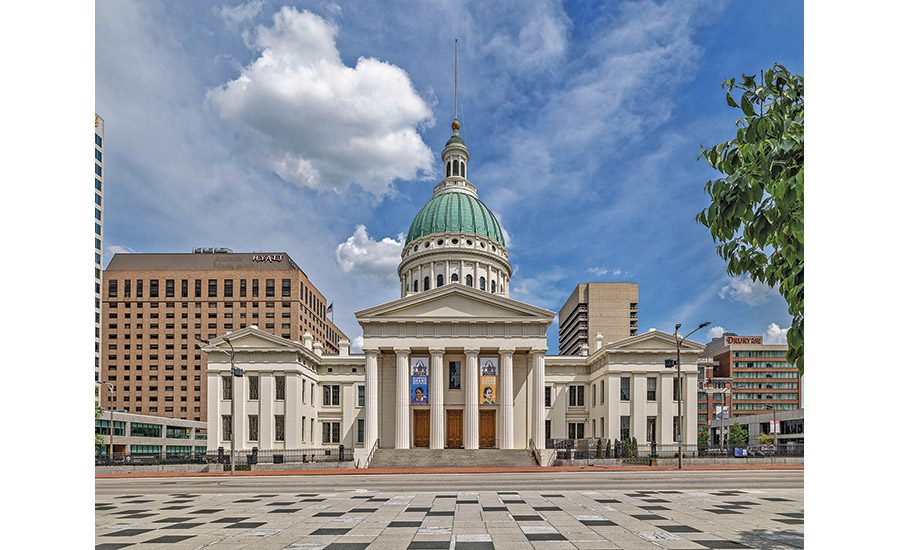
Tarlton also just completed a two-year, $27.2-million restoration of the city’s Old Courthouse.
As busy as they are, contractors are coping with various challenges including higher material costs. But McCoy sees a bright light there, too.
“Material prices, though high, have regained some stability,” he says, adding that long lead times are still affecting certain electrical gear and mechanical equipment.
Interest rates are playing a role in future construction plans.
“The uncertain interest rate environment remains unfavorable for certain development and new construction starts, leading to financing hurdles and project delays, which makes it challenging for contractors to predict backlog and resource needs,” McCoy contends.
The original courtrooms were renovated as part of a $2.7-million effort to preserve the historic Old Courthouse in St. Louis.
Image by Sam Fentress
The health care and research market also may be impacted by funding volatility.
“Uncertainty around health care and research funding may lead to softness in certain markets, but St. Louis’ diversification will continue to push the AEC market to growth,” he says.
Looking ahead, McCoy has a positive outlook for the construction industry overall.
“I predict the ACE community in St. Louis will have plenty to deliver in 2026 and beyond,” he says. “There will be much to build in St. Louis for years to come.”