

Burke
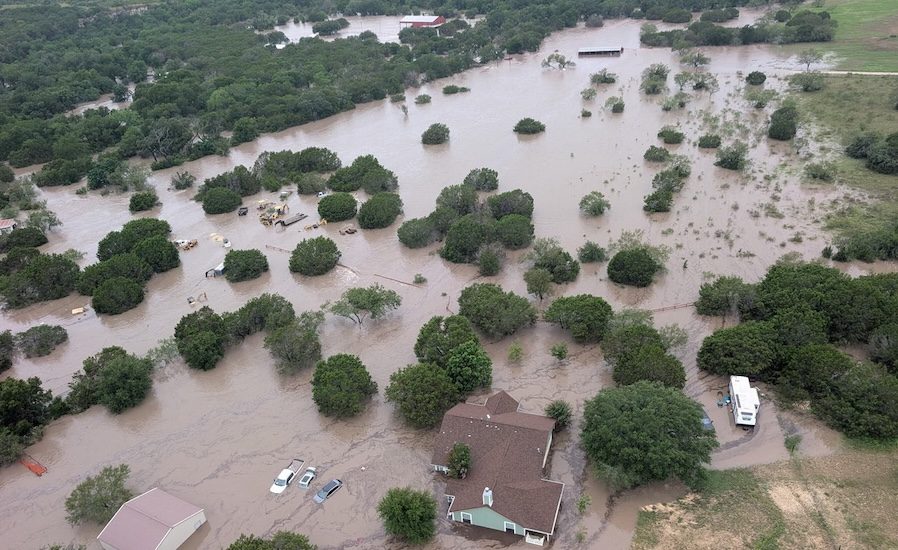
In the early morning hours of July 4, the Texas Hill Country received a record amount of rainfall; in Hunt, Texas, about eight inches fell in four hours.
As a result of the tremendous deluge, the Guadalupe River overtopped its banks and claimed 130 lives. The focus of national attention has been on Camp Mystic near Kerrville, where 27 children and staff perished. Is there an engineering solution to minimize loss of life from river flooding? As an engineer who has worked on many heavy construction projects, this is how I see the issues.
The U.S. Geological Survey has a measuring station at Hunt, so we know the typical river flow throughout the year: about 10 to 20 cubic feet per second (cfs) at this station. At 10 p.m. on July 2, the flow was 6 cfs, but only two days later the flow was a whopping 120,000 cfs. This absolutely mind-boggling flow caused the disastrous flooding on the Guadalupe River, when on July 4, it rose to 26 ft. in 45 minutes!
There have been major flash floods before in the Texas Hill Country—in 1987, 1991, 1997, 1998 and 2002. Heavy rain, rocky soil and steep terrain combine to create these devastating events.
The south fork of the Guadalupe, along which Camp Mystic is located, begins in the southwestern part of Kerr County and flows northeast for 27 miles until it meets the north fork at Hunt. At this point, the combined forks become the “Guadalupe River.” The river’s north fork rises in the western part of the county, flows east for 29 miles until it merges with the south fork at Hunt and then flows for about 250 miles to the Gulf of America.
There are several possible engineering options.
Like all rivers, the Guadalupe riverbed can carry only so much water. To minimize floods, engineers often enlarge the riverbed to allow it to carry more water downstream. River channelization often includes removing trees and shrubs that partially block the flow of water. This work has already been done by the recent flood’s scouring action.
Another measure is to widen and deepen the riverbed. This is accomplished by excavating or dredging the riverbed. Once again, the floods have scoured most of the loose material away, but there might remain places where the riverbed should be widened or dredged.
Although they would compromise the appearance of the river, I believe floodwalls could also help. These should be built in selected locations along the north and south forks, of reinforced concrete about 2 ft. high. A floodwall that is any higher would make it fairly difficult for campers to get to the river.
The Guadalupe River system has a number of dams, but they are downstream from Hunt, Texas. Many of these below Kerrville were built in the 1920s and 1930s, and are in bad condition, although some have been repaired. There are no major dams on the south or north forks, but there are a number of low dams designed to form small lakes.
How Dams Would Protect Lives
This south fork and north fork area of the Guadalupe River needs larger dams. They would provide the most protection, allowing floodwater to be stored safely in reservoirs after a high rainfall event and released at appropriate times.
I propose studying the potential for two dams, near the headwaters of each fork, both 60-ft high of roller-compacted concrete with a crest elevation of 2,100 ft above mean sea level. Both dams should include floodgates and concrete-lined spillways with tainter gates. By damming the river at these locations, enough water would be captured from several tributaries to reduce downstream flooding.
Civil engineers should also look for additional possible damsite locations along the two forks. Cypress Creek empties into the south fork at Camp Mystic, and an additional dam should be built upstream on this creek.
There are many environmental and financial reasons for allowing the Guadalupe River to remain as it is, but human lives cannot be replaced. Engineering solutions would allow campers to stay close to the river with much less risk.
Henry Burke, who was a registered professional engineer for many years, is retired from Kiewit Corp. He can be reached at hwburke25@gmail.com.






