Construction technology has changed dramatically over the past two to three years, and understanding what’s coming next, along with what contractors should do now, has never been more important.
What’s different today is that AI and data are no longer “the next big thing.” They are quickly becoming the baseline for how contractors protect margins, scale productivity and make faster decisions with leaner teams. The conversation has shifted from buzzwords to real advantages on the jobsite.
The rapid coming of age for construction AI
According to a 2025 Dodge Construction Network study, 87% of contractors believe AI will have a meaningful impact on their business. What stands out most is not just belief, but speed. A few years ago, companies were experimenting with AI. Today, many are using it in daily workflows, and the gap between testing and scaling continues to shrink.
You do not need to be an AI expert to benefit. However, the longer companies wait, the harder it becomes to catch up.
Here are several practical forces making AI unavoidable:
- Labor shortages in the field and the office
- Margin pressure from competition and rising costs
- Inflation and geopolitical volatility, especially painful for long-duration jobs
- A flood of digital tools and data, creating both opportunity and overwhelm
Importantly, contractors are not adopting AI to replace workers. The real goal is to make existing teams more productive while keeping risk low. The real interest centers on reducing time spent on data entry, improving data accuracy and freeing people to focus on higher-value work.
The real problem: adoption is rising faster than confidence
One striking contradiction across the industry is that while most contractors are already using AI in some form, only a small percentage consider themselves “above average” in technology advancement. That gap tells a critical story. The challenge is not whether AI is being used, but whether teams trust it, understand it and can implement it safely.
Confidence, not capability, is the bottleneck.
Digitization = automation?
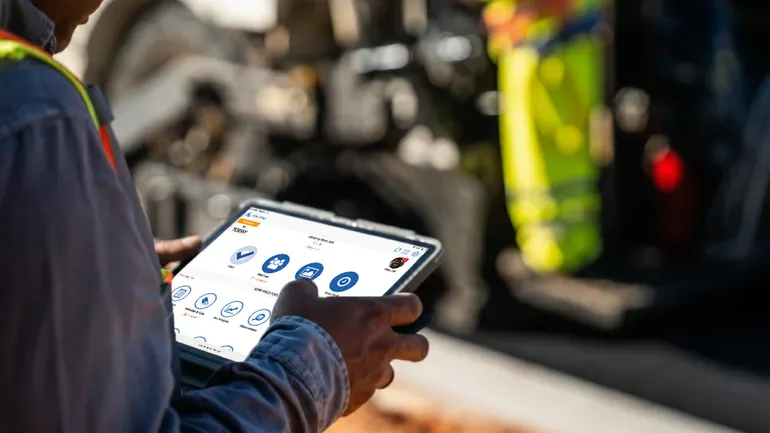
AI doesn’t live in a vacuum. It represents the next phase of a broader trend: digitizing paper-based processes using laptops, iPads and field data capture, which is now evolving into automation that reduces manual work.
Two enablers have made this shift possible:
- Better connectivity (5G, satellite, expanding broadband)
- Cloud-first workflows where field and office share real-time environments
That said, there’s a major pain point among contractors right now caused by too many apps, too many logins and the fact that these systems are largely disconnected. No organization wants to go on a scavenger hunt to figure out which tool has which answer. While many vendors claim they “integrate,” real-world integrations are often expensive and/or ineffective.
As the user experience becomes more efficient, it only makes sense that strategies will involve consolidations. Contractors want platforms that talk to each other, ultimately reducing the number of systems workers must learn.
Five ways to prepare your business for AI success
Successful AI integration isn’t about the software you invest in, it’s about the foundation you build.
Here are five strategic moves to ensure your business is ready to scale:
- Start with people and process, then technology: Identify workflow problems before investing in AI.
- Target manual, slow, disconnected workflows: Anywhere a human is acting like a computer is an automation opportunity.
- Invest in data quality and standardization: Better AI outcomes require better inputs.
- Train early, and treat training as risk mitigation: This isn’t to be looked at as overhead, nor should it be optional. This is how you can scale safely.
- Adopt AI where ROI is obvious today, and build toward bigger wins: Document workflows, reporting, and scheduling are strong starting points.
The bottom line for the coming year
Here is the reality. Much of what is labeled “AI” today is not true AI. Many tools are simply rules-based automation wrapped in trendy marketing. Contractors should be skeptical, but not discouraged.
AI is poised to transform construction faster than previous technology shifts. The cloud took years to reshape jobsites. AI is moving on a much shorter timeline. What will ultimately power this change is consistent data entry, high data quality and reliable capture systems.
Construction firms that start early, focusing on fundamentals rather than hype, will gain a lasting competitive advantage as data analytics and real-time decision-making reshape how the industry works.
Learn more about HCSS Copilot, the first natural language AI tool of its kind in the civil construction marketplace.