
A worker repeatedly steps into an unguarded edge to “just finish one task. ”A ladder is used where a platform should have been installed. A machine guard is removed temporarily and quietly becomes permanent.
Nothing happens—until it does.
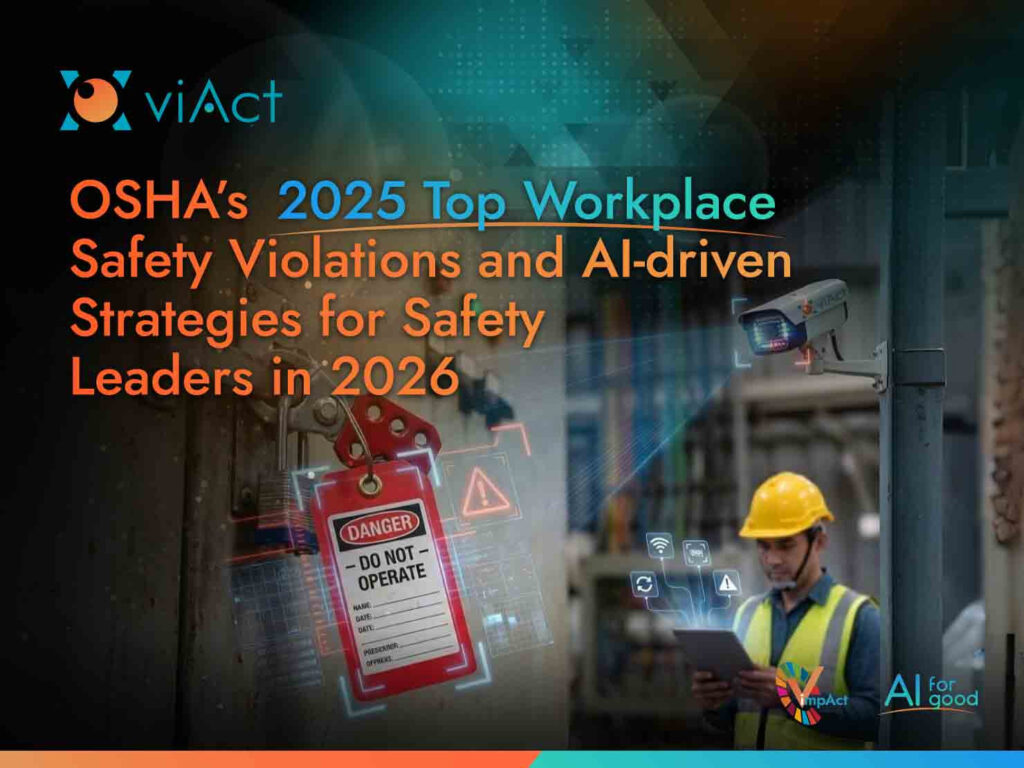
When Occupational Health and Safety Administration (OSHA) releases its annual Top Workplace Safety Violations, the list is often read as a backward-looking compliance report. But for safety leaders operating in complex environments—construction megaprojects, automated warehouses, manufacturing plants, oil & gas facilities—this list represents something far more critical:
A concentrated snapshot of risks that were visible long before they became violations.
As we move into 2026, safety leadership is shifting from responding to citations to preventing the conditions that make violations inevitable. This is where AI-driven safety technologies—video analytics, computer vision, drones, edge intelligence, and IoT—are redefining how risk is identified, measured, and reduced.
OSHA’s Workplace Safety Violations 2025: What the Data Really Shows
Across industries, the same hazards continue to surface, not because standards are unclear, but because modern worksites are evolving faster than manual oversight can keep up.
In 2025, OSHA recorded thousands of violations across the following recurring categories:
-
Fall protection failures in elevated and temporary work environments
-
Gaps in hazard communication as materials and chemicals move rapidly across sites
-
Unsafe ladder use during short-duration or informal tasks
-
Lockout/Tagout breakdowns under production pressure
-
Respiratory, eye, and face protection lapses in fluctuating exposure zones
-
Scaffolding instability in constantly changing site conditions
-
Vehicle–pedestrian conflicts involving powered industrial trucks
-
Missing or bypassed machine guards on legacy and modified equipment
|
The Problem with OSHA’s 2025 Top Workplace Safety Violations Most of these hazards:
|
In the sections that follow, we examine each major OSHA violation category—not just in terms of what went wrong, but what it reveals about underlying risk, and how AI-driven safety strategies can help organizations prevent the same failures from repeating.
1. Fall Protection (1926.501)
– Why it remains OSHA’s #1 violation in 2025
Fall protection continues to top OSHA’s list year after year, especially across construction, manufacturing facilities with mezzanines, warehouses with racking systems, and maintenance operations in oil & gas and utilities. For the year 2025, the reported number of violations for fall protection general requirements were 5914 and in terms of training violation were 1907.
Investigations repeatedly cite:
-
Unprotected edges on elevated work platforms
-
Improper use of guardrails and safety nets
-
Missing or unused personal fall arrest systems
-
Temporary work-at-height activities treated as “low risk”
According to the U.S. Bureau of Labour Statistics, falls to a lower level account for over one-third of all fatalities in construction, and a significant portion occur during short-duration or non-routine tasks, such as inspections, equipment adjustments, or material handling at height.
How AI Strategies for Workplace Safety Changes the Equation
AI video analytics and computer vision systems when integrated into monitoring processes of these industrial sites either through CCTVs or drones, they can continuously monitor elevated zones to detect any form of distraction.
For example, suppose a in high-rise construction project in Singapore, façade installation, mechanical work, and material lifting are happening simultaneously across multiple elevations. Traditionally, fall protection compliance would be checked during scheduled site walks. In practice, this leaves long windows where guardrails are temporarily removed, access routes shift, or workers step into exposed edges to complete short tasks—often without detection.
With AI-powered OSHA compliance solutions, the system continuously scans elevated zones using computer vision models trained to understand human posture, PPE usage, and spatial relationships.
The moment a worker enters a height-restricted area without a harness, or approaches an unprotected edge where guardrails are missing, the system identifies the exposure—not as a violation after the fact, but as a live risk condition. Alerts are triggered in real time, allowing supervisors to intervene before a fall occurs.
AI drones extend this visibility further. In industrial plants or complex construction environments, many of the most dangerous fall risks exist in areas that are difficult or unsafe for humans to access—roof edges, crane jibs, structural steel connections, or elevated pipe racks.
AI-powered drones enable:
-
Inspection of hard-to-reach elevated structures without human exposure
-
Monitoring of active work at height during crane operations
-
Validation of fall protection measures across large or complex footprints
As exposure data accumulates, the system builds a long-term risk profile rather than a one-time compliance snapshot.
2. Hazard Communication (1910.1200)
– Why “Right to Know” still breaks down
Hazard Communication violations are common across manufacturing, chemical processing, logistics hubs, and maintenance-intensive environments with a reported 2546 violations in 2025.
Despite the standard being well-established, OSHA continues to find gaps between documentation and actual worker awareness. These issues occur as high hazard elements at site like chemicals are moved, transferred, or decanted frequently as temporary workers and contractors rotate in and out. This creates latent exposure, where workers interact with hazardous substances without understanding cumulative or long-term risk.
AI-Enabled Insights for 2026
AI-powered systems integrated with the workflows enable safety teams to move beyond document-based hazard communication toward real-world exposure visibility. By analysing live site activity, these systems can:
-
Visually verify chemical labeling and container identification at points of use
-
Detect unsafe handling behaviours, such as improper decanting or missing PPE
-
Correlate hazard exposure zones with specific tasks, crews, and time windows
For instance, in a manufacturing facility where solvents are used across multiple production lines, safety data sheets may be correctly filed and training records up to date. However, AI-enabled cameras observe that containers are frequently transferred into unlabelled secondary bottles during peak shifts. At the same time, workers are seen handling these substances without the required gloves or eye protection.
By correlating visual detection with task schedules and zone data, the system highlights that hazard communication failures are occurring during process transitions, not during formal operations.
3. Ladders (1926.1053)
– Small equipment, disproportionate risk
Ladders remain one of OSHA’s most frequently cited hazards with in 2405 violations, not because they are inherently complex, but because they are easy to access and often underestimated.
AI-Driven Strategy for 2026

In 2026, safety leaders must treat ladder use as a behavioural exposure signal, not a minor equipment issue. When AI modules are trained to recognise ladder presence, orientation, and use patterns across worksites, instead of waiting for an injury, the system now flags how ladders are being used over time.
This allows organisations to eliminate ladders as a default solution and replace them with engineered access controls before injuries occur.
4. Lockout/Tagout (1910.147)
– When production pressure overrides energy control
Lockout/Tagout (LOTO) violations remain prevalent in manufacturing, food processing, energy, and heavy equipment maintenance, where production continuity often competes with safety controls.
With 2177 violations, OSHA Observes causes involving incomplete isolation of hazardous energy sources, missing or improperly applied lockout devices and maintenance or cleaning performed by unauthorised personnel. Many fatal incidents occur during routine maintenance tasks, where equipment is assumed to be safe but remains energised.
Strategy for OSHA Compliance in 2026
AI-enabled monitoring systems correlate maintenance activity, equipment state, and worker access to identify when energy control steps are bypassed.
What AI enables in practice:
-
Detection of maintenance activity occurring on equipment that remains energised
-
Alerts when unauthorised personnel enter restricted maintenance zones
-
Pattern recognition highlighting repeated LOTO deviations under production pressure
This shifts LOTO from a paperwork requirement to a live exposure control system, aligned with real operational behaviour.
5. Respiratory Protection (1910.134)
– Invisible hazards, delayed consequences
Respiratory protection violations remain widespread across industries involving dust, fumes, vapours, or confined spaces—including construction, mining, manufacturing, and oil & gas. The violation can occur due to incorrect respirator selection or the absence of fit testing or medical clearance
AI-Enabled Insights for 2026
|
Respiratory risk is dynamic, often fluctuating with: Now, the AI-integrated systems create a context aware understanding by automatically correlating:
|
This supports exposure-based respiratory risk management, shifting focus from long-term health outcomes to proactive exposure reduction.
6. Scaffolding (CFR 1926.451)
– Temporary structures, permanent consequences
Scaffolding violations are common across construction, shipyards, and industrial maintenance sites, where scaffolds are erected, modified, and dismantled frequently. In the recent tragic fire incident in Hong Kong, bamboo scaffolds were identified as causes for the quick spread of fire.
The violations around scaffolds often in terms of improper or incomplete assembly or overloading. Scaffold failures tend to impact multiple workers simultaneously, significantly increasing injury severity.
The AI-based Strategy for 2026
An integrated system using both AI vision systems and drones to monitor scaffold configuration, load conditions, and access behaviour throughout the workday is required.
What AI enables in practice:
This transforms scaffold safety from a static checklist into a dynamic exposure management process.
7. Powered Industrial Trucks (1910.178)
– Human–machine interaction failures
Powered industrial trucks, including forklifts, cranes, excavators and pallet movers, remain a leading source of serious injuries across warehouses, manufacturing facilities, ports, and logistics hubs, causing 1826 violations.
AI-Driven Strategy for 2026 with Edge-Based Movement Intelligence
In 2026, leading safety programs are shifting from incident response to continuous human–machine interaction analytics.
Today, AI-based surveillance, can be deployed on edge devices connected to existing cameras and vehicle-mounted sensors. They combine camera feeds with vehicle and proximity sensors to accurately detect close interactions, even in blind spots or low-visibility areas.
Processing at the edge ensures fast alerts, privacy compliance, and scalability across large warehouses and plants. With edge intelligence and sensor data combined, safety leaders gain:
-
Identification of high-risk traffic intersections and blind spots based on actual movement density
-
Detection of unsafe speed, reversing, or sharp manoeuvres relative to pedestrian proximity
-
Measurement of near-miss frequency and severity as a leading risk indicator
8. Eye and Face Protection (CFR 1926.102)
– Last line of defence, often ignored
Eye and face protection violations persist in environments with flying debris, chemical splashes, or high-pressure systems. It is observed that worker often wear incorrect or inadequate PPE, tend to remove protection during short tasks and eely on informal judgement rather than task-based requirements.
AI-Driven Strategy for 2026
AI-powered PPE detection modules with computer vision technology brings an additional layer of monitoring. It enables:
-
Ensured Activity-focused PPE compliance
-
Continuous verification of PPE compliance during active tasks
-
Immediate alerts when protection is missing
-
Pattern analysis to identify recurring non-compliance
This helps safety teams address behavioural trends, not just individual violations.
9. Machine Guarding (CFR 1910.212)
– The most severe, yet most normalised risk
Machine guarding violations remain stubbornly common in manufacturing and processing facilities, particularly those operating legacy equipment. With 1239 reported violations, it remains one of the most severe OSHA violations because exposure is tolerated until an injury happens.
The AI Strategy for Workplace Safety in 2026
What AI enables in practice:
-
Detection of removed or bypassed machine guards
-
Monitoring of repeated unsafe proximity during specific tasks
-
Exposure trend analysis across shifts and production cycles
This enables safety leaders to prioritise engineering interventions and eliminate systemic risk. For example, when AI cameras detect frequent guard removal during changeovers on one production line in a factory floor, immediate strict SOPs covering this area is applied.
The 2026 Safety Leader’s Imperative
In 2026, effective safety leadership will not be defined by lower citation counts—but by measurable reductions in risk exposure. AI-enabled strategies allow organizations to anticipate violations before inspections, intervene before injuries, redesign work before enforcement and lower the TRIR overall.
OSHA’s data is no longer just a compliance benchmark. For forward-looking EHS leaders, it is a predictive roadmap—one that, when combined with AI, can finally break the cycle of repeat violations and reactive safety management.
1. Can AI really help reduce repeat OSHA violations, or is it just monitoring?
Yes. AI goes beyond monitoring by identifying behavioural patterns, exposure trends, and near-miss signals that typically precede OSHA violations—allowing corrective action management before enforcement or injury occurs. Platforms like viAct focus on exposure reduction, not just compliance reporting
2. How does AI for fall protection work, OSHA’s #1 violation?
AI video analytics continuously detect missing harnesses, unsafe edge proximity, unguarded openings, and elevated work risks using site cameras and drones. The AI modules converts fall protection from periodic inspection into real-time exposure control using real time data.
3. Is AI in workplace safety deployment complex for live industrial sites?
No. Modern AI safety systems like viAct are designed for plug-and-play deployment, integrating with existing CCTV infrastructure, drones, and edge devices—without disrupting ongoing operations.
4. Are these AI systems scalable across multiple sites?
Yes. Such safety systems supports multi-site scalability, standardized risk scoring, and centralized dashboards—making it easier to compare exposure trends across projects, plants, or regions.
5. Why are safety leaders in 2026 choosing viAct specifically?
viAct stands out because it:
-
Focuses on data-based risk measurement
-
Combines AI video analytics, edge processing, drones, and analytics
-
Is built specifically for high-risk industrial environments
-
Helps organizations move from reactive OSHA compliance to predictive safety leadership
Wish to tackle OSHA’s 2025 Top Workplace Safety Violations
with AI-driven Strategies?